I’m trying to bridge a Quectel RM-520N module to provide network access to connected devices. The goal is to set up the module in bridge mode (IP passthrough) so that I can extend the network to a switch and connect multiple devices to it. I couldn’t find a extensive article on this, any help is much appreciated.
Happy to provide more information if needed. Thanks!
Yes the module connects to a raspberry pi via USB. I have tried bridging the wwan0 interface but no luck on that. I am trying to assign the IP to ethernet interface of raspberry pi rather wwan0 and then further bridge it to a switch.
Is this the right way to do it?
However, when I try AT+QMAP=“MPDN_rule”,0,1,0,1,1,“E4:5F:01:0E:CA:CF” and it says OK but still cannot get an IP on the ethernet interface.
Can you share the network topology,or describe what you want to achieve?The information available is not very accurate and may lead to unnecessary misunderstandings.
Based on the information you’ve provided, I’m guessing you may be trying to get all end devices to get a public IP issued by your ISP?
Thanks for the reply and sorry for the vague information.
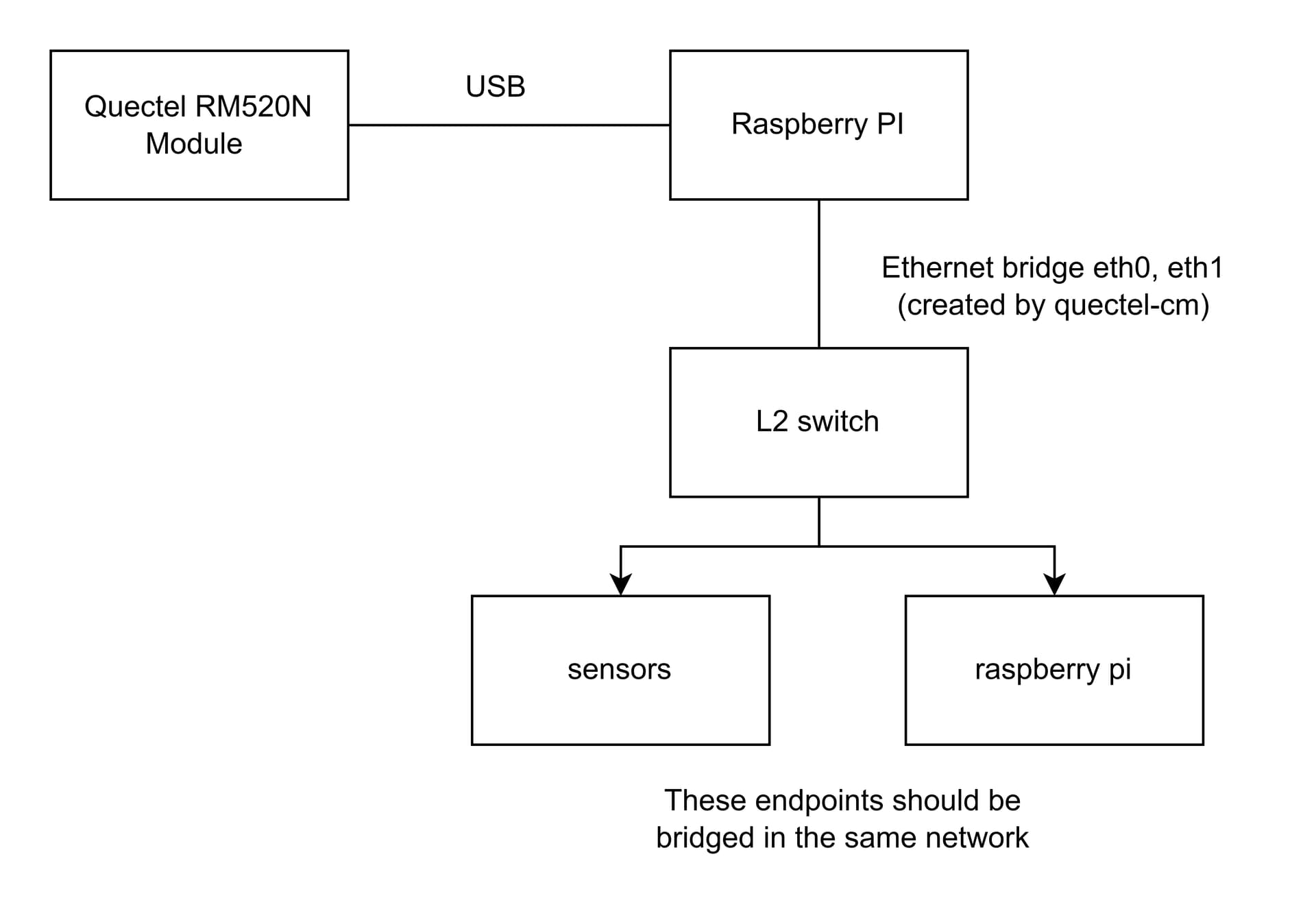
We have a private 5G network (Nokia) and Quectel RM520N UEs. I have attached the topology I am trying to acheive. I have quectel RM520N module on a custom CPE board with USB connection to a raspberry PI (Note: No ethernet interface on the CPE board). I have configured the module to use ECM mode (AT+QCFG=“usbnet”,1) which gives me an ethernet interface (eth1). I have bridged that with eth0 interface of the raspberry pi. Then I have a mikrotik switch connected to eth0 of raspberry pi and then 2 more endpoints to the other LAN interfaces of the switch. Ideally, I would like them to be bridged on the same network.
Currently we are using NAT to achieve this but it gets complicated when there are multiple endpoints involved.
hopefully this gives better understanding on what we are trying to achieve, let me know if you need any more information, happy to provide.
IP passthrough does not apply to the existing operating mode of the module. The working principle is shown in the picture (only personal understanding, may be wrong).
Maybe you can go to Raspberry Pi forum for help on how to bridge twice network interfaces.
Instead of using Raspberry Pi, connecting the module directly to the switch is the best way.